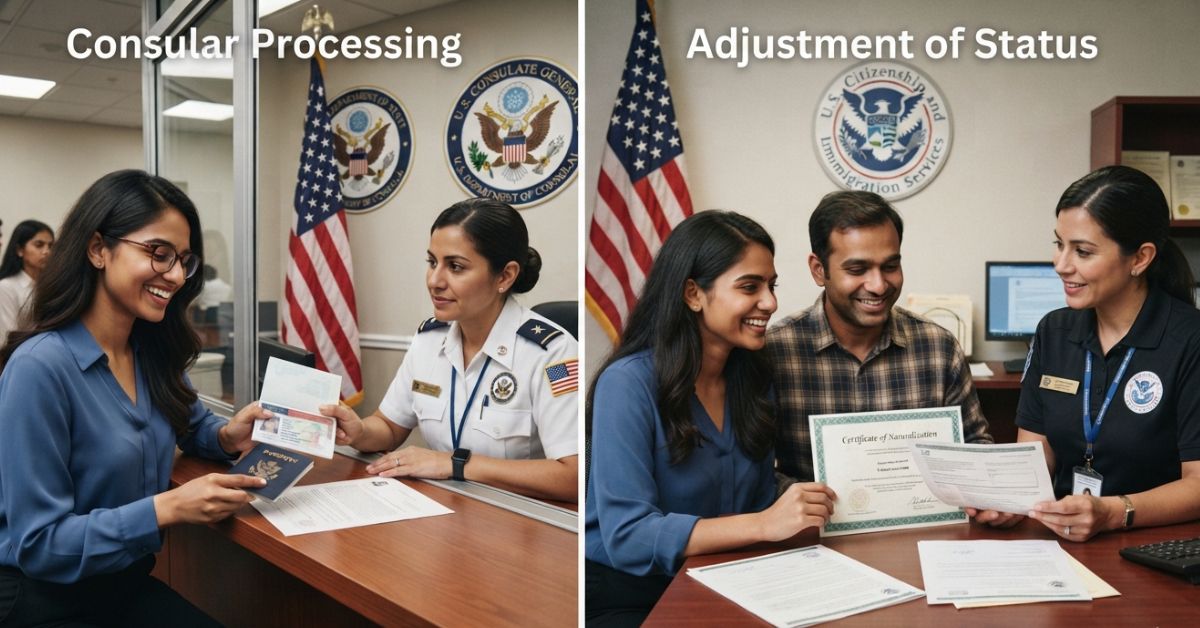

Almost every green card applicant eventually reaches the same fork in the road: consular processing vs adjustment of status. Both paths lead to the same destination, lawful permanent residence, but the route you take can affect your timeline, your travel freedom, and even your risk of denial. Choosing wrong doesn’t just cost time; in some cases, it can mean starting the entire immigration process over from scratch.
This guide breaks down how each option works, who typically qualifies for which, and what to weigh before deciding which path fits your situation.
What Is Adjustment of Status?

Adjustment of status allows someone who is present in the U.S. to apply for the green card without returning to their home country. Generally, it’s available to people who entered the country legally, have a valid visa status at the moment, and have an approved or pending immigrant petition. The application is submitted to USCIS, and the entire process of obtaining a green card takes place within the U.S.
For many applicants, this is the more convenient route simply because it avoids international travel and the uncertainty of leaving the country mid-process.
What Is Consular Processing?
Consular processing, by contrast, is handled through a U.S. embassy or consulate in the applicant’s home country. This path is typically used by people living outside the United States, or by those inside the U.S. who aren’t eligible to adjust status due to visa violations, unlawful entry, or other disqualifying factors. Once the immigrant petition is approved, the case moves to the National Visa Center and eventually to an interview abroad.
Consular processing tends to move faster in some visa categories, since it isn’t subject to the same USCIS backlog that adjustment of status cases often face domestically.
Comparing the Two Paths Side by Side
The decision between adjustment of status and consular processing usually depends on a few important factors: where the applicant is located, their current immigration status, and how much risk they are willing to take during the process.
Adjustment of status allows applicants to remain in the US during the entire process and usually includes permission to work and travel while waiting for the outcome. In contrast, consular processing requires leaving the US for an interview, which can lead to unlawful presence penalties for applicants who have been in the US illegally. This fact alone has made many applicants abandon their plans.
Why the Green Card Process Timeline Varies So Much
Cases differ in speed, and the green card process can take several months or even years depending on the country of origin of an applicant, visa type, and processing time of the consulate or USCIS. For example, family-based cases in overloaded categories may take years regardless of the chosen path due to annual caps.
Because of this variability, it’s worth checking current processing times for both USCIS field offices and the specific consulate involved before assuming one path will automatically be faster.
Factors That Should Guide Your Decision
A few questions tend to clarify which route makes more sense:
- Are you currently living inside or outside the United States?
- Do you have a valid, unexpired visa status that qualifies you to adjust?
- Have you accrued any unlawful presence that could trigger a reentry bar?
- How important is it to avoid international travel during the process?
- Does your specific visa category have significantly different wait times between the two paths?
Answering these honestly, ideally with legal guidance, prevents costly missteps that are difficult to undo once the immigration process is already underway.
Where the Firm’s Experience Extends Beyond Immigration
Navigating a life-changing legal process often means dealing with more than one area of law over time. The Rochester Law Firm’s clients sometimes come to us first for an unrelated matter, like recovering lost wages after a construction injury, before later needing guidance on a family member’s immigration case. Having a firm that understands both sides of a client’s life, financial recovery and legal status, often makes navigating multiple legal challenges considerably less stressful.
Common Mistakes That Slow Down USCIS Adjustment of Status vs Consular Processing Decisions
One of the most common mistakes is that applicants consider themselves eligible for adjustment of status without actually verifying their eligibility. Applying for adjustment by an applicant who is, in reality, ineligible will result in an automatic denial, and in some cases removal proceedings may commence. On the consular side of the process, it happens that an applicant misjudges how unlawful presence bars affect his chances and only realizes it after leaving the country for an interview.
Weighing USCIS adjustment of status vs consular processing carefully before filing anything is far safer than correcting course after a mistake has already been made.
How an Attorney Helps You Choose the Right Path

Different processes involve different risks, deadlines, and required documentation, and the consequences of making a wrong choice can be serious. A reliable consular processing attorney NYC will be able to analyze your previous visa experience, current status, and family situation, and recommend the best possible solution to your problem as well as avoid the mistakes of other applicants.
Which Path Is Right for You?
There is no universal answer when it comes to consular processing and adjustment of status. The best option will depend on where you are at the moment, your immigration experience, and how much risk you are comfortable with in this process. The most critical thing is to be informed about your case beforehand so you don’t find an issue that will disqualify you while you are doing so.
We at The Rochester Law Firm help our clients get clarity regarding both processes, making this process less of a guessing game and more of a plan that you can rely on. If you need a consultation regarding which option is better for you, please do not hesitate to contact us.
Frequently Asked Questions
Can I switch from adjustment of status to consular processing if my case gets complicated?
In some instances, yes. In the event that USCIS either denies an adjustment application or even prolongs its processing, one may be able to pursue consular processing instead. Nevertheless, it would be dependent upon specific instances and thus require proper evaluation by a lawyer.
Is consular processing faster than adjustment of status?
When comparing the time necessary to complete the adjustment of status process through USCIS or consular processing, it would be accurate to say that it depends on the visa category and country. While some consulates are able to complete applications more rapidly than USCIS, others face a backlog as significant as those at USCIS. Hence, current processing timelines must be checked before asking which option is best.
Will I be able to work while my adjustment of status case is pending?
Often, yes. Many adjustment applicants are eligible to apply for work authorization while their green card case is pending, though this isn’t automatic and depends on the underlying visa category.
What happens if I leave the U.S. while my adjustment of status application is pending?
Leaving without proper advance parole authorization can be treated as abandoning your application, so it’s critical to confirm travel eligibility before making any plans while a case is pending.